

Kenya has unveiled a new strategy to transform its sugar industry into a bio-economy and energy hub, a move aimed at improving competitiveness, increasing revenue streams and supporting millions of livelihoods.
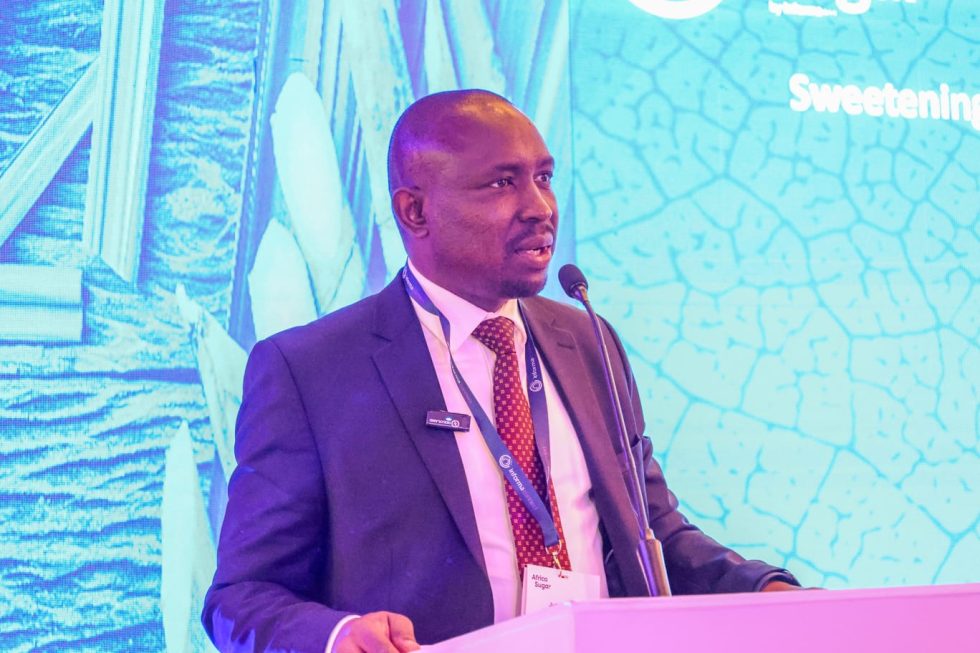
Speaking at the Informal Africa Sugar Conference, Kenya Sugar Board (KSB) Chief Executive Officer Jude Chesire, said the country is moving away from a narrow focus on sugar production towards a broader, value-driven approach.

Kenya Sugar Board (KSB) Chief Executive Officer Jude Chesire (right) at the the Informal Africa Sugar Conference. Photo/Fredric Odiero
“We are at an inflection point. Kenya is ready to lead Africa’s next chapter by transforming our sugar industry into a diversified, sustainable and competitive agro-industrial powerhouse,” Chesire said.
He said the industry must rethink what it produces in order to remain viable, stressing that the future lies in expanding beyond sugar and fully exploiting the economic potential of sugarcane.
According to Chesire, the strategy focuses on turning byproducts that were previously considered waste into valuable commercial products. This, he said, will position the sector as a major contributor to economic growth and renewable energy development.
He noted that the industry currently supports more than eight million people and could become a key pillar of the economy if modernised effectively.
A major part of the plan involves increasing ethanol production by scaling up the distillation of molasses. This is expected to meet rising industrial demand while also offering a cleaner and more sustainable fuel option.
At the same time, the sector is expanding green energy generation by using bagasse the fibrous material left after crushing sugarcane to produce electricity. The excess power generated through this process will be supplied to the national grid.
The industry is also looking to widen the use of industrial molasses in emerging bio-based sectors, with the aim of ensuring that every part of the sugarcane is utilised efficiently.
“This approach ensures nothing goes to waste while maximising returns from the crop,” Chesire said.
He added that diversifying into ethanol and energy production will help sugar mills cut operational costs and reduce their exposure to fluctuations in global sugar prices.
To support these changes, the KSB is implementing a modernisation programme designed to improve productivity and efficiency.
This includes introducing high-yield cane varieties with greater biomass and sugar content, as well as increasing the mechanisation of farming activities.
The board also plans to expand the use of Geographic Information Systems (GIS) mapping and precision agriculture technologies to promote more sustainable and efficient cane production.
Chesire said the KSB is repositioning itself from a regulatory body to a strategic leader that will guide the sector’s transformation.
New policy measures will focus on rebuilding farmer confidence through fair pricing and transparent contracts. The aim is to ensure that growers benefit directly from new revenue streams linked to ethanol and energy production.
He also highlighted opportunities under the African Continental Free Trade Area (AfCFTA), saying Kenya could broaden its exports to include bio-based industrial products across the continent.
Chesire added that the shift towards bio-energy and sustainable practices is in line with global environmental, social and governance (ESG) standards.
He said increased use of renewable energy and climate-smart agriculture will help reduce the industry’s carbon footprint.














Leave a comment