

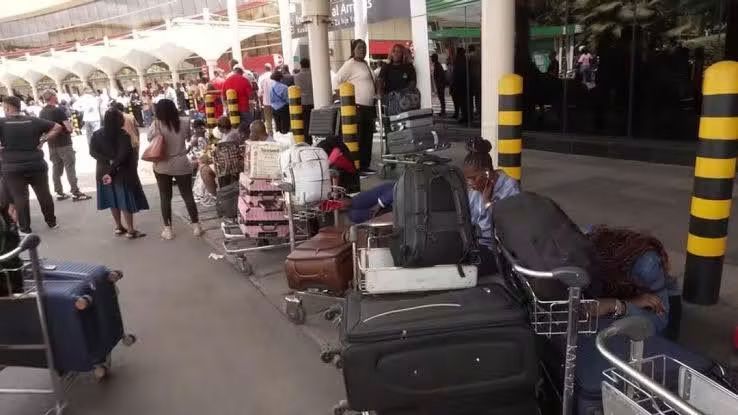
Thousands of travellers have faced long delays, cancellations and missed connections at the Jomo Kenyatta International Airport (JKIA) as a go slow by aviation workers enters its second day.
The industrial action at JKIA was called by the Kenya Aviation Workers Union (KAWU) after the union accused aviation authorities of failing to honour commitments made under an agreement that had suspended an earlier planned strike.
The disruption has affected JKIA and other airports, forcing airlines to reschedule flights as they try to clear a growing backlog.Kenya Airways said some flights had been delayed by more than six hours.
The airline advised passengers to check their flight status before travelling to the airport. It said those wishing to reschedule would not be charged a penalty.
But what are passengers entitled to when a flight is delayed or cancelled?Airlines are generally expected to keep passengers informed about changes to their flights.
What assistance is available can depend on the length of the delay, the reason for it and the airline’s conditions of carriage.
In the current disruption at JKIA, airlines are mainly rescheduling flights and trying to clear the backlog as airport operations recover.
Passengers whose flights are delayed may be moved to the next available service.
Those whose flights are cancelled may be rebooked on another flight.If passengers are forced to wait for several hours or overnight, airlines may, depending on the circumstances and their applicable policies, provide meals, accommodation or transport.
Reports from JKIA on Monday indicated that some airlines had started moving passengers who spent the night at the airport to hotels.
The disruption can be more complicated for passengers travelling with connections.
A traveller flying from Nairobi through an international hub, for example, could miss an onward flight because of a delay at JKIA.
If the entire journey was booked on one ticket, the airline will generally try to rebook the passenger on the next available connection.
Passengers who booked separate tickets may have fewer options. A missed connection on a separate booking may not be covered by the airline operating the first flight.
Travellers should therefore contact their airline as soon as possible rather than making their own arrangements.
Kenya Airways says passengers whose flights are delayed by more than eight hours and who decide not to travel can apply for a refund.
The airline is also allowing affected passengers to rebook without penalties, subject to the conditions it has issued for the disruption.
For wholly unused tickets, passengers can request a full refund.Those who have already completed part of their journey can seek a refund for the unused portion.
Kenya Airways says refund penalties have been waived and that passengers have until 20 September 2026 to submit refund requests.
Passengers should keep their booking information and receipts for any expenses incurred while waiting for further instructions from their airline.
Some travellers at JKIA said they had received little warning before arriving at the airport.
George Ouma, who was due to travel to Dubai, said passengers had been left waiting without clear information about when their flight would depart.
“There was no warning and that’s the problem. The flight was for 1pm and we are yet to be told when we will leave,” he said.
Jael Mureithi said her flight, also scheduled for 1pm, was later moved to 20:50.”We are very frustrated. We were here at 10am and were told that there is a strike. The flight has since been scheduled for 8:50pm tonight,” she said.
Kenya Airways has urged passengers to check their flight status before travelling to the airport and to make sure their contact details are up to date so they can receive notifications.
KAWU says the strike follows unresolved disputes involving workers at the Kenya Airports Authority (KAA), the Kenya Civil Aviation Authority (KCAA) and airline Jambojet.
The union’s secretary-general, Moss Ndiema, said an earlier agreement to return to work had failed to resolve the workers’ grievances.
“We did sign a back-to-work formula but, unfortunately, KAA and KCAA failed to meet our demands,” he said.
They have never committed to the negotiations and have failed to cooperate and show effort in resolving our grievances. We therefore lifted the suspension on the strike.
The dispute includes disagreements over a collective bargaining agreement, pay, welfare and working conditions.
KAA said it was working with aviation agencies, airlines and other stakeholders to reduce the disruption.
“The Authority is working closely with the relevant aviation agencies, airlines and other stakeholders to manage the situation, minimise disruption and facilitate the smooth flow of airport operations,” it said.
The effects have also been felt outside Kenya. RwandAir cancelled two Nairobi-bound flights on Sunday, citing air traffic control challenges.
JKIA is a major regional aviation hub, so prolonged disruption can affect flights across East Africa as aircraft, crews and passengers fall behind schedule.
For now, thousands of travellers remain uncertain about when they will reach their destinations as airlines work to clear the backlog.
If the industrial action continues, delays at JKIA could have wider effects on regional schedules, leading to more missed connections and cancellations.













Leave a comment