

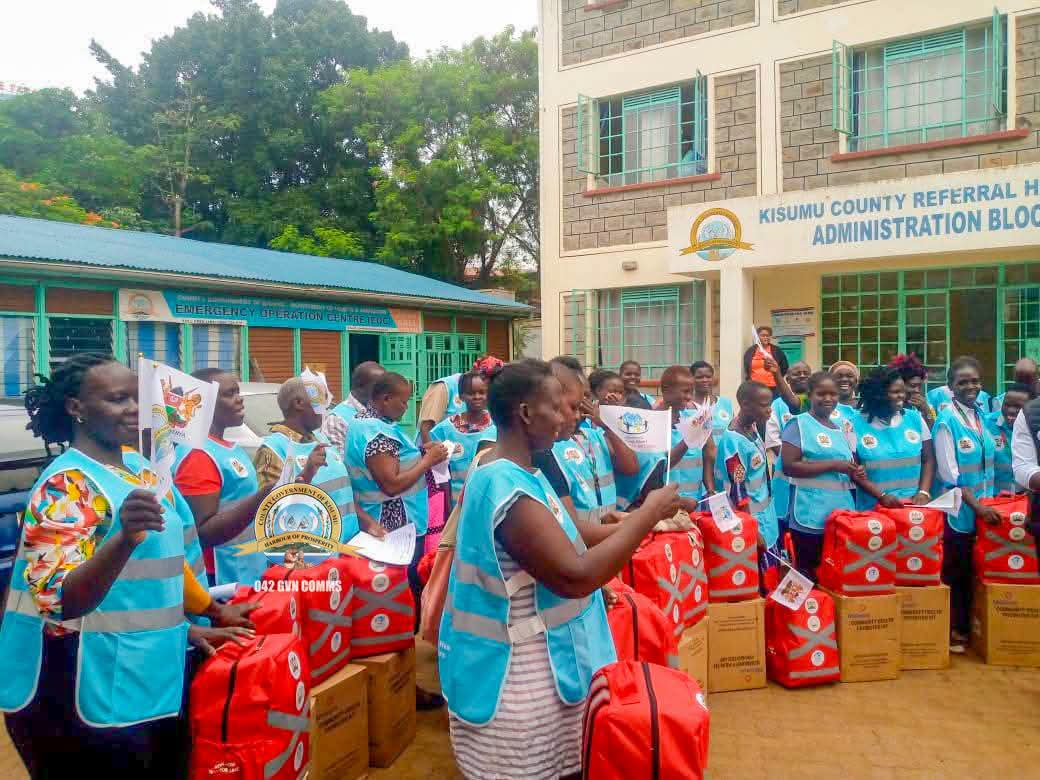
The Kisumu County government has invested Sh600m in community health programmes, supporting nearly 3,000 community health promoters (CHPs) to provide healthcare services at household level.
The investment has supported 2,943 CHPs working across 291 community health units and equipped them with digital tools through the electronic Community Health Information System (eCHIS).
The county says 330,678 people have been registered through digital community outreach, with 206,151 regularly receiving services at community level.
Governor Anyang’ Nyong’o said the programme was changing how healthcare was delivered by taking services closer to residents rather than waiting for them to seek treatment at health facilities.
“Our CHPs are registering families, identifying pregnant women and children at risk, providing basic services, promoting prevention and making referrals when specialised care is required,” Prof Nyong’o said.
Between 2021 and 2025, CHPs made 11.48 million household visits and referred 71,341 pregnant women for antenatal and other maternal health services.
The county says antenatal care use increased by 83% over the period, while maternal mortality fell from 495 to 343 deaths per 100,000 live births.
Under-five mortality also declined from 67 to 37 deaths per 1,000 live births, according to county data.
CHPs also managed 264,032 malaria cases among children under five and 242,514 cases among older patients between 2021 and 2025.
They additionally treated 90,530 cases of diarrhoea using zinc and oral rehydration salts (ORS).
Prof Nyong’o said the county’s community-based approach had also informed the Marwa Social Health Insurance programme, which supported more than 30,000 vulnerable residents.
He said experience gained through Marwa contributed to its integration into the national Social Health Authority framework.
“The health system I have been building is not one that waits for citizens to come looking for government, but one that takes government to the people,” he said.
He added that the effectiveness of a health system should be measured not only by the number of hospitals built, but also by how quickly vulnerable people are reached.
“Because the true measure of a health system is not only the number of hospitals we build, but how early we reach a mother, how quickly we identify a sick child, and how effectively we protect a family from an illness becoming a crisis,” Prof Nyong’o said.







Leave a comment