

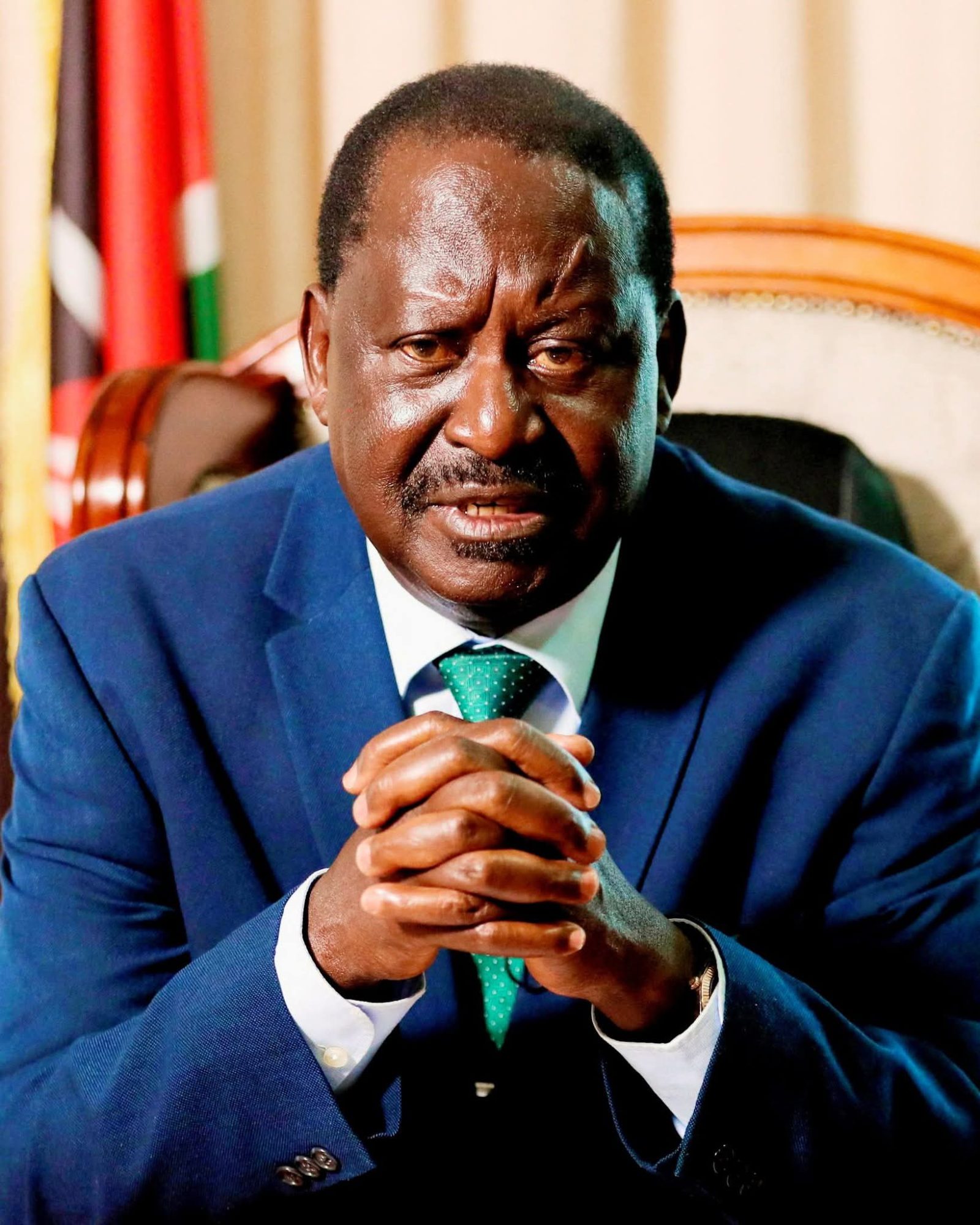
The passing of Raila Odinga must not herald the gradual erosion of the principles he championed.
On the contrary, his death should serve as a profound and urgent catalyst for introspection, compelling Kenyans, particularly those who have benefited from his enduring struggle to confront a difficult yet fundamental question.
How are we safeguarding the political and democratic inheritance he has bequeathed?Raila Odinga’s political odyssey was inextricably linked to Kenya’s protracted fight for democratic governance, constitutionalism, and political pluralism?
Long before multiparty democracy was institutionalised, he stood as a formidable challenge to a political order that stifled dissent and demanded unquestioning conformity.
His resistance to authoritarianism exacted a heavy personal toll, marked by prolonged detention, imprisonment, surveillance, political persecution, and the dislocation of his family and personal life.
The democratic liberties that many Kenyans now regard as customary did not materialise spontaneously.
The rights to political organisation, to critique the government, to assemble freely, to express dissent, and to compete for political power were hard-won by successive generations of Kenyan activists.
Odinga was among the most distinguished figures in this vanguard.This historical context renders recent developments in parts of Nyanza particularly disheartening.
A political legacy forged through immense sacrifice now risks being diminished to the crude currency of handouts, intimidation, clientelism, and internecine violence.
When young citizens are reportedly induced with modest cash payments, crude weaponry, or political directives to confront their compatriots, it is imperative to question whether this is the Kenya for which Raila fought.It is unequivocally not.
Raila Odinga consistently demonstrated an astute understanding that political disagreement is an inherent and indispensable feature of democracy.
He repeatedly illustrated that individuals could affiliate with opposing political formations, support divergent candidates, and espouse fundamentally different worldviews without descending into enmity.
Democracy is predicated on contestation; the ballot box, and not the stone, the machete, the club, or the fist, is the designated arbiter of political competition.
This principle demands resolute defence at this critical juncture.It is profoundly concerning when political actors, insulated from the consequences of their actions, leverage state resources and political influence to mobilise young people for violence.
The politician retreats to safety; the young protester bears the injury, the arrest, the criminal record, or, tragically, death.
The children of the political elite continue their lives uninterrupted, while the offspring of those used as political weapons are left to grapple with the trauma of a parent in prison, in hospital, or in a grave.
No political ambition can justify such a human cost.Nyanza must not be transformed into a theatre of conflict for the ambitions of a select few. Its youth must not be weaponised against one another for the benefit of political elites.
A community with such a storied history in Kenya’s democratic evolution must unequivocally reject the notion that political allegiance must be proven through violence.
Those found culpable for politically instigated violence must be subjected to thorough investigation and held accountable, regardless of their political affiliations or standing.
The security agencies’ primary duty is not the protection of political interests but the protection of citizens, the upholding of the Constitution, and the guarantee that every Kenyan can participate in the political process without fear.
However, the assessment of Raila Odinga’s legacy extends beyond the immediate spectre of violence; it encompasses the very meaning of political participation itself.
His entry into the broad-based government was accompanied by a ten-point agenda that pledged to address Kenya’s most pressing challenges.
Central to this was the need to confront extrajudicial killings and other egregious abuses of state power.
Yet, Kenyans continue to express deep disquiet over abductions, deaths in custody, and alleged violations of fundamental rights, as exemplified by the case of the late Albert Ojwang and other young Kenyans whose deaths have ignited public outrage.
A broad-based government cannot be evaluated by the number of political leaders it accommodates, but rather by its tangible impact on the lived experiences of ordinary citizens.
Where are the jobs? Where is justice? Where is accountability? Where are the economic opportunities? Where is the adherence to the Constitution?
Where is the demonstrable improvement in the quality of life for the average Kenyan? Political inclusion, devoid of tangible transformation, risks degenerating into a mere elite pact for power-sharing.
This is precisely why Raila’s legacy must not be reduced to the political patronage individuals anticipate receiving from the state.
His politics, at its most principled, was never solely about who secured a position, appointment, or financial allocation. It was fundamentally about whether ordinary citizens possessed a meaningful voice in determining their governance.
Those currently inquiring, “What is our share of the political cake?” would be better served by posing a more pertinent question: What is the citizen’s rightful share of democracy, dignity, justice, and development?
The political future of Nyanza and Kenya cannot be built on a foundation of handouts.
A few thousand shillings may temporarily draw a crowd, but they cannot generate sustainable employment, educate a generation, construct hospitals, administer justice, or restore a life lost to political violence.
They most certainly cannot preserve a democratic legacy.As Kenya approaches the 2027 General Election, its citizens face a conscious and consequential choice regarding the nature of their politics.
They may opt for a politics defined by personalities, ethnic mobilisation, fear, financial inducement, and violence.
Alternatively, they may choose a politics grounded in substantive issues, accountability, constitutionalism, and the everyday needs of the populace.
The latter path would be far more congruent with the democratic ideals for which Raila dedicated the majority of his political life.
Raila’s ultimate legacy should not be gauged by the number of political allies he amassed, the offices he held, or the political pacts concluded in his name.
It should be measured by the resilience and vitality of the democratic space he helped create.
If young people are being remunerated to attack one another, if political opponents are intimidated, if dissent is punished, if state power is deployed to silence citizens, and if political engagement is reduced to a competition for patronage, then we are not preserving Raila’s legacy, we are actively betraying it.
The onus now rests squarely with Kenyans themselves. They must refuse to be instruments of political violence.
They must reject a politics that compels young people to jeopardise their lives for politicians who will never share in the consequences.
They must demand tangible development over empty slogans, accountability over patronage, and justice over impunity.Raila Odinga fought so that Kenyans could disagree without fear of imprisonment for their opinions.
He fought for a Kenya in which political authority could be legitimately contested. He endured detention and persecution because he believed that citizens deserved greater democratic freedoms.
We owe it to that profound sacrifice not to transform democracy into a marketplace where political handouts purchase loyalty and violence settles disputes.
Let Nyanza reject the politics of bloodshed. Let Kenya reject the politics of fear.
Let the nation organise around issues, not personalities; around citizens, not political beneficence; and around democracy, not violence.
This would constitute a fitting and enduring tribute to Raila Odinga, not merely by invoking his name, but by steadfastly defending the democratic principles for which he paid such a heavy price.
The writer is a seasoned journalist and political commentator.









Leave a comment